

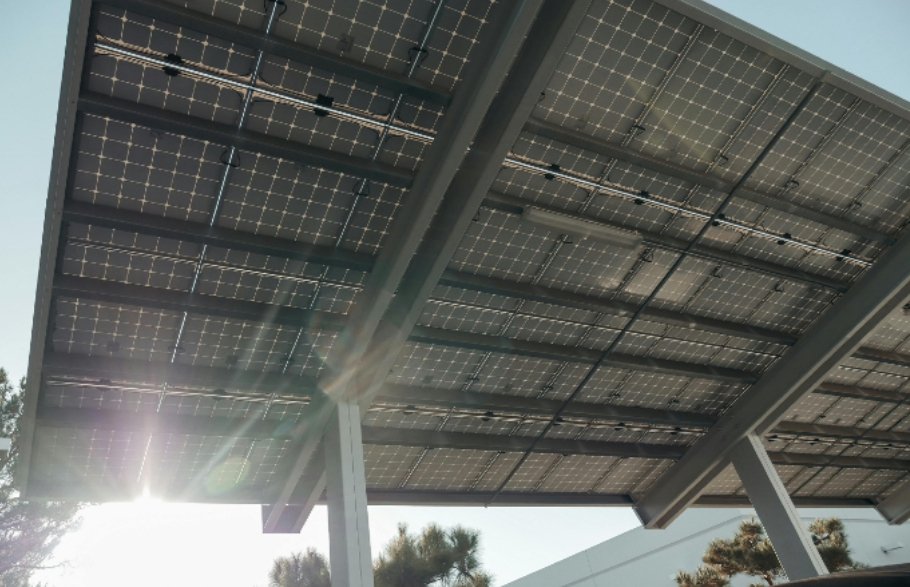
Bifacial solar panels capture light from both sides, generating electricity from direct sunlight and reflected light bouncing off surfaces below. Unlike standard panels with opaque backing, bifacial modules have solar cells on both surfaces. The question is whether Edinburgh’s historic urban environment can deliver the conditions needed to justify their higher upfront cost in residential as well as commercial installation settings.
How Bifacial Solar Panels Actually Work
Traditional solar panels have an opaque backing, so they only convert sunlight hitting the front surface. Bifacial panels use a transparent or reflective rear sheet, with solar cells on both sides. The front side captures direct sunlight just like standard panels, whilst the rear side generates additional electricity from light reflected off the ground, rooftops, or nearby surfaces.
This reflected light is measured by albedo, essentially how much light a surface bounces back. Fresh snow has an albedo of around 80 to 90%, meaning it reflects most light. Concrete sits at roughly 25 to 35%, whilst grass is lower at 15 to 25%. The rear side of bifacial panels typically generates an extra 5 to 30% energy compared to standard panels, depending on installation conditions and ground surface.
Edinburgh’s Climate and Bifacial Performance
Edinburgh receives approximately 1,400 hours of sunshine annually. Bifacial panels don’t require blazing heat, they need light, including diffuse light on cloudy days. The city’s frequent overcast conditions create diffuse light bouncing around, which can benefit bifacial panels in certain installations.
However, Edinburgh’s northerly latitude (56°N) means lower sun angles, especially in winter, affecting how much light reaches the rear of panels. Ground mounted bifacial systems perform better than roof mounted ones because they allow light to reach the back surface more easily. On a typical Edinburgh roof, rear side gains are often minimal, usually 5 to 10% extra output, because there’s limited space for reflected light to reach panels mounted flush or at low angles.
Installation Considerations for Edinburgh Properties
Bifacial panels work best when installed with specific conditions in mind. Ground mounted systems with reflective surfaces underneath (like white gravel or light coloured paving) can achieve the 20 to 30% rear side gains that make bifacials attractive. They need to be elevated, typically 1 to 2 metres off the ground, to allow light to reflect underneath.
For rooftop installations, which make up the vast majority of residential solar in Edinburgh, the benefits are less pronounced. Standard pitched roofs don’t provide much opportunity for rear side light capture. The panels sit close to roof tiles or slates, leaving little room for reflected light. Unless you have a flat roof with a highly reflective membrane and use tilted mounting systems that elevate panels significantly, you’re looking at only marginal rear side gains.
Commercial properties with large flat roofs and reflective white membrane surfaces can see better bifacial performance. Industrial buildings, warehouses, and some commercial premises across Edinburgh may have the roof conditions that make bifacials more viable. But for typical residential pitched roofs with traditional slate or tile, common throughout New Town and Old Town, the extra cost of bifacials (usually 10 to 20% more than standard panels) often doesn’t justify the modest performance increase.
Cost Benefit Analysis for Edinburgh Homeowners
Let’s look at the numbers. A standard 4 kW residential solar system in Edinburgh might cost around £5,000 to £7,000. Bifacial panels would push that to roughly £5,500 to £8,400. If the bifacial system generates 7% more energy (a realistic figure for an Edinburgh rooftop installation), you’re looking at perhaps an extra 250 to 300 kWh per year.
At current electricity rates, that’s about £75 to £90 in additional annual savings. It would take roughly 7 to 10 years just to recover the extra upfront cost from the marginal efficiency gains. Standard monocrystalline panels, meanwhile, are proven, reliable, and cost effective for Edinburgh’s conditions.
Bifacials make more financial sense if you’re installing a ground mounted system with optimal conditions: light coloured gravel, proper elevation, and good spacing between panel rows. In these scenarios, the 15 to 25% rear side gains can justify the premium. But that’s not the typical Edinburgh residential installation, particularly given conservation area restrictions in many historic neighbourhoods.
When Bifacials Make Sense in Edinburgh
Bifacial panels suit specific applications in Edinburgh: ground mounted systems with reflective surfaces and adequate spacing, particularly for properties with available land in areas like South Edinburgh or West Edinburgh; commercial flat roofs with white TPO or PVC membrane roofing, using elevated mounting systems; solar farms or large scale installations where optimising every square metre matters and conditions can be controlled; and future proofing for battery storage, where the marginal extra generation might be worthwhile.
For standard residential rooftop installations on pitched roofs, which represent most Edinburgh homes, high efficiency monocrystalline panels offer better value. They’ve dropped significantly in price, now offer efficiencies above 20%, and deliver proven performance in Scotland’s climate without requiring special installation considerations.
The Practical Verdict for Edinburgh
Bifacial solar panels are genuine technology, not a gimmick. They do generate extra electricity from both sides. But whether they’re worth it in Edinburgh depends entirely on your installation conditions. If you’re putting panels on a typical residential roof with standard slate or tile, the modest rear side gains don’t justify the extra cost. You’ll get better return on investment with high quality standard panels.
If you have a ground mount opportunity, a commercial flat roof with reflective surfaces, or a property where you can create optimal bifacial conditions, perhaps in Leith or Stockbridge, then they’re worth considering. The key is being realistic about the actual performance gains you’ll see in Edinburgh’s urban environment and climate, rather than chasing the headline 30% rear side figures that apply to ideal laboratory or desert conditions.
For most Edinburgh homeowners, proven monocrystalline panels remain the sensible, cost effective choice. They’ll deliver reliable solar generation for 25 plus years without the installation complexity or premium pricing of bifacials.
